
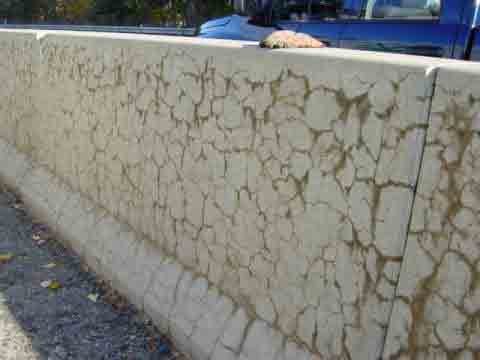


Alkali-silica reaction (ASR) is a major durability concern in concrete structures, leading to expansion, cracking, and loss of strength. To mitigate ASR, various chemical admixtures and supplementary cementitious materials (SCMs) are used to neutralize or suppress the reaction. This section discusses the most effective admixtures, their mechanisms, and their application in concrete mix design.
Lithium-Based Admixtures
Lithium compounds are among the most efficacious chemical admixtures employed to mitigate alkali-silica reaction (ASR) in concrete. Their primary mechanism involves the modification of ASR gel chemistry, resulting in the formation of non-expansive lithium-silicate phases, thereby reducing deleterious expansion associated with conventional alkali-silica gels (Folliard et al., 2006).
The efficacy of lithium admixtures is strongly influenced by the lithium-to-silica molar ratio (Li/SiO₂). Empirical studies indicate that a minimum molar ratio of approximately 0.74 is required to achieve effective suppression of ASR-related expansion (Thomas & Stokes, 2004).
Types of Lithium Admixtures
- Lithium Nitrate (LiNO₃): This is the most widely used lithium compound, favored for its high aqueous solubility and proven effectiveness in ASR mitigation. Recommended dosages generally range from 25% to 50% by mass relative to the equivalent alkali content expressed as Na₂Oₑ (McCoy & Caldwell, 2001).
- Lithium Carbonate (Li₂CO₃): Exhibiting lower solubility compared to lithium nitrate, lithium carbonate is less effective as an ASR suppressant and may induce early stiffening in concrete mixes, which can complicate workability and placement.
- Lithium Hydroxide (LiOH): While highly effective in mitigating ASR, lithium hydroxide can increase the overall alkalinity of the cementitious matrix, potentially impacting other durability aspects.
Advantages and Limitations
Lithium-based admixtures offer the significant advantage of effectiveness even when applied at later stages of ASR development, including potential injection into existing, ASR-affected structures. However, their application is constrained by high material costs, which limit widespread usage. Furthermore, excessive lithium dosing may adversely affect concrete setting times and mechanical properties, necessitating careful dosage control.
Supplementary Cementitious Materials (SCMs)
Supplementary cementitious materials (SCMs) play a pivotal role in mitigating alkali-silica reaction (ASR) by modifying the chemistry of the cementitious pore solution. Their primary mechanisms include reduction of pore solution alkalinity and consumption of calcium hydroxide (CH), which is essential for the formation of expansive ASR gel.
- Fly Ash
- Class F Fly Ash (Low CaO, <10%): Characterized by high silica content, Class F fly ash is generally more effective in ASR mitigation due to its pozzolanic activity, which consumes CH and reduces available alkalis. Effective dosages typically range from 20% to 40% cement replacement by mass (Shehata & Thomas, 2006).
- Class C Fly Ash (High CaO, >20%): While less reactive than Class F, Class C fly ash can still contribute to ASR suppression, particularly when used at replacement levels of 30% or greater.
- Ground Granulated Blast Furnace Slag (GGBFS): GGBFS is a latent hydraulic material that requires replacement levels of 50% or higher to effectively mitigate ASR (Thomas, 2011). Its incorporation reduces pore solution alkalinity and refines the concrete microstructure, thereby enhancing durability.
- Silica Fume (Microsilica): Silica fume is an extremely reactive pozzolan that rapidly consumes calcium hydroxide, contributing to pore solution modification and microstructural densification. Typical replacement levels range from 5% to 10% (Nixon & Sims, 2016).
- Metakaolin: Metakaolin, a highly reactive calcined clay, effectively reduces alkali availability and refines pore structure at replacement levels between 8% and 15%, thereby contributing significantly to ASR mitigation (Ramlochan et al., 2000).
Pozzolanic Admixtures (Natural & Artificial)
Natural Pozzolans in ASR Mitigation
Natural pozzolans, including materials such as volcanic ash and diatomaceous earth, have demonstrated potential for mitigating alkali-silica reaction (ASR) through their pozzolanic reactivity and chemical interaction with the cementitious matrix.
Mechanism
Natural pozzolans react with calcium hydroxide (CH) to form additional calcium-silicate-hydrate (C-S-H) gel, thereby consuming CH and reducing the concentration of alkalis in the pore solution. Certain natural pozzolans, such as rice husk ash, possess particularly high silica reactivity, which enhances their capacity to mitigate ASR by immobilizing reactive alkalis.
Limitations
The effectiveness of natural pozzolans is highly variable and depends on factors such as mineralogical composition, particle size, and source-specific reactivity. Due to this variability, natural pozzolans often require higher replacement levels-typically 20% or greater-to achieve meaningful ASR mitigation.
Calcium Nitrate and Barium Salts
Calcium Nitrate (Ca(NO₃)₂)
Calcium nitrate functions as an ASR mitigating admixture primarily by modifying the chemical composition of the ASR gel, thereby reducing its expansive potential (Bleszynski & Thomas, 1998). Although it is generally less effective than lithium-based compounds, calcium nitrate offers a more economical alternative for ASR control in concrete.
Barium Salts (Ba(OH)₂, Ba(NO₃)₂)
Barium salts mitigate ASR by forming insoluble barium-silicate phases that inhibit the development of expansive gels. However, their practical application is limited due to concerns regarding barium toxicity and environmental safety, which restrict widespread adoption despite their efficacy.
Blended Systems: Integration of SCMs and Lithium-Based Admixtures
The combined use of lithium nitrate with supplementary cementitious materials (SCMs) such as fly ash or ground granulated blast furnace slag has been demonstrated to synergistically enhance the suppression of alkali-silica reaction (ASR). This blended approach leverages the complementary mechanisms of SCMs, which reduce pore solution alkalinity and consume calcium hydroxide, alongside lithium’s modification of ASR gel chemistry. Consequently, the integration allows for the use of reduced lithium dosages while maintaining effective ASR mitigation, thereby improving the economic feasibility of lithium application in concrete (Folliard et al., 2006).
Performance Evaluation of ASR-Inhibiting Admixtures
The efficacy of alkali-silica reaction (ASR) inhibiting admixtures is commonly assessed using standardized test methods, including:
- ASTM C1567: An accelerated mortar bar test incorporating supplementary cementitious materials (SCMs) to evaluate their effectiveness in mitigating ASR expansion.
- ASTM C1293: A long-term concrete prism test that provides more representative assessment of ASR potential under field-simulated conditions.
- RILEM AAR-5: A performance-based testing protocol specifically designed to evaluate the effectiveness of chemical admixtures in controlling ASR in concrete mixtures.
References
- Folliard, K. J., et al. (2006). Guidelines for the Use of Lithium to Mitigate ASR in Concrete. FHWA Report.
- Thomas, M. (2011). The Effect of SCMs on ASR: A Review. *Cement and Concrete Research, 41(12), 1224-1231.
- Shehata, M. H., & Thomas, M. D. A. (2006). The Effect of Fly Ash Composition on ASR in Concrete. *Cem. Concr. Res., 36(7), 1253-1256.
- Nixon, P. J., & Sims, I. (2016). RILEM Recommendations for ASR Prevention. *Materials and Structures, 49(10), 4093-4106.



Leave a Reply